
When the Fourth Summit of the Americas was held in Mar del Plata in 2005, Hugo Chavez announced the burial of the FTAA, the "Free Trade Area of the Americas". “FTAA, FTAA: to hell with it!” he declared to a cheering crowd at the Mar del Plata World Cup stadium. In addition to social organizations from across Latin America, he was accompanied by the Mothers of Plaza de Mayo; Nobel Peace Prize laureate Adolfo Pérez Esquivel; football idol Diego Maradona; labor leader Evo Morales (a year away from becoming president); Cuban singer Silvio Rodríguez; and many others. Now a Nobel Laureate, Adolfo Esquivel continues the struggle.
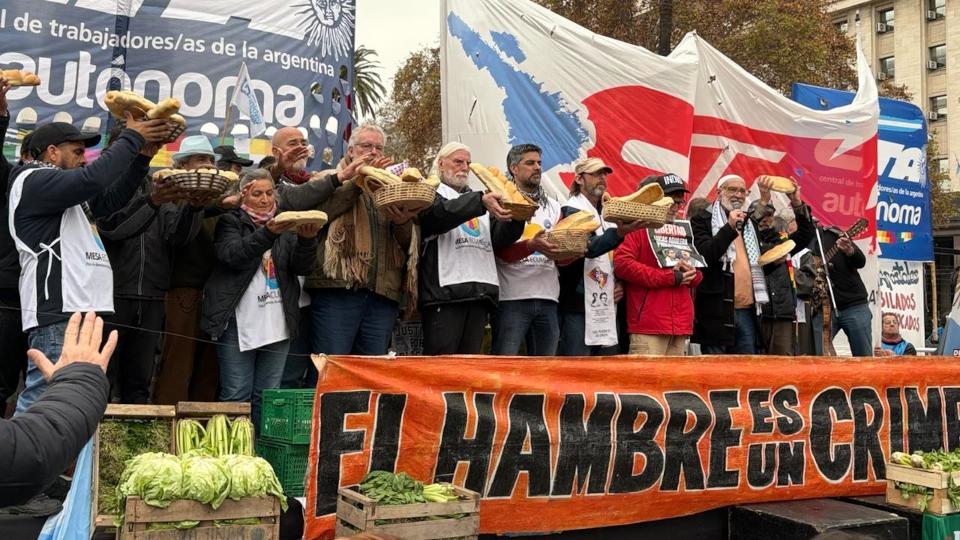
The fasting concluded in Plaza de Mayo: “hunger in a country made of bread is an ethical and political crime”
10 June, 2026 by Agencia Andar/CPM
translated from https://argentina.indymedia.org/2026/06/10/concluyo-el-ayuno-en-plaza-de-mayo-el-hambre-en-un-pais-hecho-de-pan-es-un-crimen-etico-y-politico/
After 7 nights, and with a massive turnout, the Ecumenical Table concluded this Tuesday the days of fasting and prayer to denounce hunger and inequality. The president of the CPM and Nobel Peace Prize, Adolfo Pérez Esquivel, promoter of this campaign stressed that the fast was a cry of democratic resistance to look at the brother who does not have to eat. Father Miguel “Pancho” Velo, one of those who maintained the fast and member of the CPM, said during the blessing at the close of the day: “Let us stretch our arm to raise the fallen of this country, may the Lord bless us and make us a shared bread.”
Last Tuesday, June 9, concluded the campaign of “Fasting and prayer to awaken consciences” in the Plaza de Mayo. This eight-day protest, which began on Tuesday, June 2, in Plaza Congreso, was promoted by Nobel Laureat, Adolfo Pérez Esquivel, together with the Ecumenical Table for Democracy, Life and the Common Good.
“Freedom cannot be the freedom of the market to speculate and merge a people. There is no true freedom without social justice, without public education, without health and sovereignty. To be in this Plaza de Mayo, which has so much memory of struggle, forces us to say clearly: we will not allow the democratic pact that cost us so much blood to rebuild,” said Pérez Esquivel, reference of the struggle for human rights and president of the Provincial Commission for Memory (CPM).
Father Miguel “Pancho” Velo, also a member of the CPM and one of the citizens this week, questioned in harsh terms the government of Javier Milei: “I think they no longer feel. They must even believe that their policies are good. They do not know the pain they cause, the wounded flesh of the people who are here with us. They’re on another planet, they believe that with Artificial Intelligence or the invented numbers of balances fix everything.”
The closure of this protest coincided with a strong National Day of Protest that transferred the claim to the union and public mobilization plane. The two main aspects of the Central Workers of Argentina (the Autonomous CTA, led by Hugo “Cachorro” Godoy, and the Workers’ CTA, led by Hugo Yasky) marched from noon to join and give a massive framework to the closure of the fast in Plaza de Mayo. In the closing scenario, also spoke the priest Rodolfo Viano, the pastor of the evangelical church Leonardo Schindler, the general secretary of ATE Capital Daniel Catalano and the reference of the Muslim community in Argentina Sheikh Mohsen Ali.
In addition to union leaders and political and social organizations, the closing day also participated in the closing day by the CPM Elsa Pavon, Pastor Peter Rochon, Ana Barletta, Ana Soffiantini, María Sonderéguer, Ernesto Alonso and Executive Secretary Roberto Cipriano García, and General Director Sandra Raggio.
The unitary act focused on denouncing the situation of “hunger and exclusion”, the scrapping of state structures and the rejection of the reforms of the management of La Libertad Avanza, with special focus on the repeal of the Labor Modernization implemented by the government of Javier Milei.
Throughout the week, the tent and ecumenical space mounted on the square functioned as a daily meeting point. Sectoral debates, cultural activities and specific visibility days were held, such as last Sunday focused on the rights of people with disabilities. The initiative also had replicas of reflection and fasting in central squares of different provinces of the interior of the country. “They call us to the rebellion of consciences against injustices so that together we can build a better society. Our people never gave up values such as solidarity and humanism,” the union leaders said in the closing speech, replicating the message that Pérez Esquivel expressed on the first day of the call.
Active non-violence
In the closing act of the fast, Pérez Esquivel, delivered a speech full of humanistic mysticism, appealing to peaceful resistance and launching harsh criticism of the current socio-economic situation. He clarified that this week of fasting was not an act of weakness or resignation, but a political action of “active non-violence” aimed at ethically questioning rulers and society. “This fasting and prayer has not been a lament of victims, but a cry of democratic resistance. We have laid the body because the words seem to have lost their value to those who govern. Fasting is stripping to look in front of the brother who has nothing to eat. Hunger in a country made of bread is not an economic crisis, it is an ethical and political crime,” he said.
Likewise, true to the position he has historically held with the Third World Church and human rights movements, he defined extreme poverty and lack of food as a planned violation of human rights. The reference criticized the delivery of natural resources, the dismantling of scientific and educational institutions, and labor reforms that weaken the social fabric. And finally, he urged the “rebellion of consciences” to overcome apathy and social fragmentation, calling for the unity of the trade union, social and cultural sectors.
In a message to the new generations and to the militancy, Pérez Esquivel urged: “Do not fall into discouragement or the provocation of violence. Violence is the recourse of those who have no arguments. Our strength is truth, solidarity and community organizing. I call you to walk together, not to lose hope, because hope is not waiting for things to change, hope is to build change every day.” The speech closed between applause from the union columns of the CTA and various social organizations, consolidating the role of Pérez Esquivel, at 94 years old, as one of the most persistent ethical and consultation references in the arc of human rights in Argentina.
For his part, Father Miguel “Pancho” Velo, member of the group of Priests in Option for the Poor and one of the religious who carried out the complete fast of seven nights in the Plaza de Mayo, explained the sense of the protest, criticized the insensitivity of official policies and called for social unity to “summon a place like the Plaza de Mayo to the different sectors of struggle that are sometimes a little fragmented.”
Velo made a clear difference between the action of the protesters and the reality experienced by the most vulnerable sectors of society: “I can afford to fast, but the people are obliged to fast, to eat once a day with luck. The people do not separate faith from struggle, because it does not separate faith from life.”
Unity in the Fight
Meanwhile, the secretary general of the Autonomous CTA, Hugo “Cachorro” Godoy, had an active role in both the accompaniment of the fast and in the organization of the federal march that sealed the closure of the protest. His statements focused on giving a sense of ethical urgency to the mobilization, warning about the impact of official measures on daily life and calling for greater unity to avoid the dispersal of the protests. “The intention is to summon the personal and spiritual effort to commit ourselves all, to trust in our strengths as men and women who personify the Homeland, and that today is so overwhelmed. This task requires a rebellion of consciences,” he said. The leader warned about the widespread mood of the population, describing a scenario of unprotection that goes beyond the economic:
“We regret the spiritual crisis, in addition to material, very great that most Argentines are going through. [We seek] to embrace this initiative and say that we are willing to work hard to modify this harsh and cruel reality that we suffer.”
In justifying the confluence of different sectors in the Plaza de Mayo, Godoy listed the areas that, according to the analysis of the workers’ power plant, are suffering the greatest adjustment: public health, disability care, education and employment. One of the points in which he insisted the most was on the need to unify the different sectoral protests – doctors, teachers, mayors, social movements –, under the same umbrella of resistance.
At the strictly trade union level, and coordinating the unitary mobilization with the Workers’ CTA led by Hugo Yasky, Godoy stressed that the goal of maximizing the trade union presence in the street is to press politically to achieve the repeal of the Labor Modernization Law.